
Burning Plastic Is Not Recycling, And Recycling Does Not All Go To Landfill
- Kate Fenwick

- Jun 19
- 4 min read
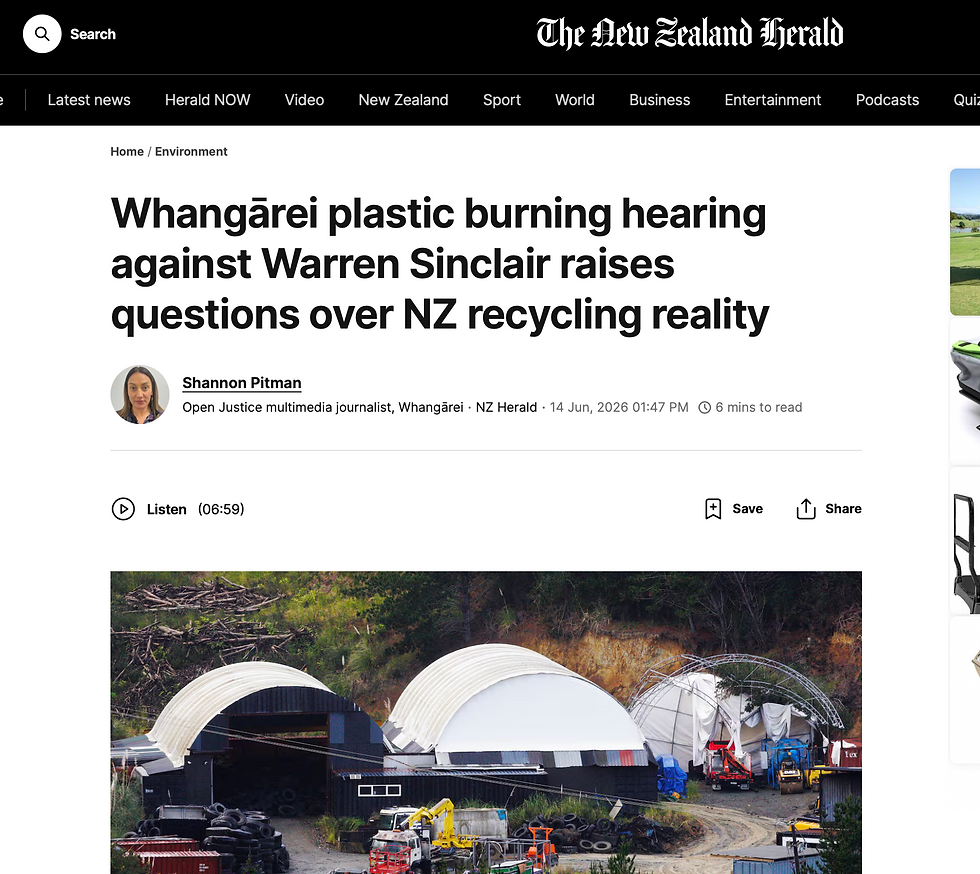
A recent article about a Whangārei plastic burning case has raised a much bigger question for New Zealand. https://www.nzherald.co.nz/environment/whangarei-plastic-burning-hearing-against-warren-sinclair-raises-questions-over-nz-recycling-reality/D4E2NQRQ5FETXKU6BV7P2JR6VY/
Do people actually trust recycling?
And if they do not, why not?
The article discussed an Environment Court hearing involving allegations around a plastic pyrolysis operation. During the hearing, questions were reportedly raised about whether there is much difference between burning plastic and sending it to landfill, and whether much of New Zealand’s recycled plastic ends up in landfill anyway.
I understand why people are confused.
I understand why people are cynical.
And I understand why so many people feel like recycling is a bit of a mystery once the truck drives away from the kerb.
For years, households have been told to “do the right thing”, but they have not always been given clear, consistent and transparent information about what actually happens next.
Some materials are recycled well......Some are not.
Some plastics are collected in kerbside recycling......Some are not.
Some materials have strong markets......Some are technically recyclable, but not practically recyclable in every region.
But there is one myth I want to address clearly.
Recycling does not all go to landfill
One of the most damaging things people say about recycling is:
“It all goes to landfill anyway.”
That is not true......I have filmed the proof.
I have followed recycling through real facilities here in Aotearoa New Zealand. I have shown what happens to materials like plastic, glass, tins, cans, paper and cardboard after they leave the kerbside.
I have seen the sorting systems.
I have seen the machinery.
I have spoken with the people working inside the system.
I have seen materials being separated, processed, baled, transported and sent on for further use.
Is the system perfect?.....No.
Does contamination cause problems?.....Yes.
Are some materials rejected?.....Yes.
Do we urgently need to reduce the amount of waste and packaging being created in the first place?
Absolutely.
But saying that recycling is pointless because it “all goes to landfill” is not only incorrect, it is harmful.
It stops people participating in the parts of the system that do work.
It undermines the people and businesses doing the hard work behind the scenes.
And it lets producers off the hook by turning a design and infrastructure problem into a household blame game.
Burning plastic is not recycling
The other issue this article raises is the idea that burning plastic, or using technologies such as pyrolysis, could be a solution to our plastic waste problem.
I want to be very clear about this......Burning plastic is not recycling.
Whether it is called pyrolysis, waste to energy, advanced recycling, plastic upcycling or something else, we need to be very careful about any technology that relies on us continuing to produce large volumes of plastic waste.
Plastic is made from fossil fuels.
Turning plastic into fuel, or burning it, does not magically make it circular.
It destroys material. It can create further environmental questions. And it risks giving businesses and consumers the false comfort that we can keep producing endless plastic because there will always be a machine at the end to make it disappear.
But there is no “away”.
Landfill is not away.
Exporting waste is not away.
Burning plastic is not away.
Any operation dealing with plastic waste in this way must be held to proper environmental standards, proper consent processes, proper monitoring and full transparency.
Communities deserve to know what is being processed.
They deserve to know what emissions are being produced.
They deserve to know what residues are left behind.
They deserve to know who is profiting.
And they deserve to know whether the activity is genuinely reducing harm, or simply shifting it into another form.
Recycling still matters, but it is not the whole answer
Recycling was never meant to solve the entire waste problem. It sits below refusing, reducing and reusing for a reason. The best waste is the waste we never create in the first place.
We need better product design.
We need less unnecessary packaging.
We need stronger reuse systems.
We need more producer responsibility.
We need investment in the recycling systems that actually work.
And we need honesty about the materials that do not belong in kerbside recycling at all.
But recycling still matters.
Clean, correct recycling protects the value of materials that can be recovered.
It supports local jobs.
It reduces the need for virgin resources.
And it gives us a foundation to build better systems from.
So when people say, “Why bother recycling?”, my answer is this:
Bother because the good materials need to stay good.
Bother because contamination makes the system harder and more expensive.
Bother because the workers in recycling facilities are dealing with the consequences of what we put in our bins.
Bother because recycling is not perfect, but it is still part of the solution.
We need more transparency, not more myths
The public mistrust around recycling is real. And the way to fix that is not to dismiss people’s concerns. The way to fix it is with proof.
Show people where their recycling goes.
Show people what happens inside the facilities.
Show people which materials are actually recycled and which are not.
Show people the difference between a recyclable item and an item that simply has a recycling symbol on it.
Show people why clean recycling matters.
Show people the truth.
That is why I make my proof of recycling videos.
Because people deserve to see what happens beyond the bin.
And I would warmly invite anyone who believes recycling all ends up in landfill, including decision makers, councils, businesses, media, community leaders and people involved in conversations like this, to watch them.
Not because the system is perfect......But because the truth matters.
The bigger question
At the end of the day, the question is not only:
“What do we do with all this plastic?”
The bigger question is:
“Why are we producing so much of it in the first place?”
We cannot recycle our way out of overproduction.
We cannot burn our way out of the plastic crisis.
And we cannot keep asking households to carry the responsibility for a system they did not design.
New Zealand needs less waste, better design, more reuse, stronger recycling, and far more transparency.
Recycling does not all go to landfill.
But burning plastic is not the answer either.


The article highlights critical issues surrounding recycling, particularly the public's growing skepticism about its efficacy. The assertion that "it all goes to landfill" reflects a broader societal frustration with a system that lacks clarity and transparency. Engaging in practices like Spinbet can further complicate this narrative, as they divert attention from fundamental problems in waste management. A holistic approach is necessary for meaningful change.
This article brings to light significant concerns about the recycling system in New Zealand. The notion that recycling is ineffective because it all goes to landfill, while a prevalent sentiment, warrants deeper investigation. The discussion illustrates that labeling burning plastic as a solution is misguided. Highroller practices can obscure the true environmental impact, highlighting the crucial need for greater transparency in recycling processes.